
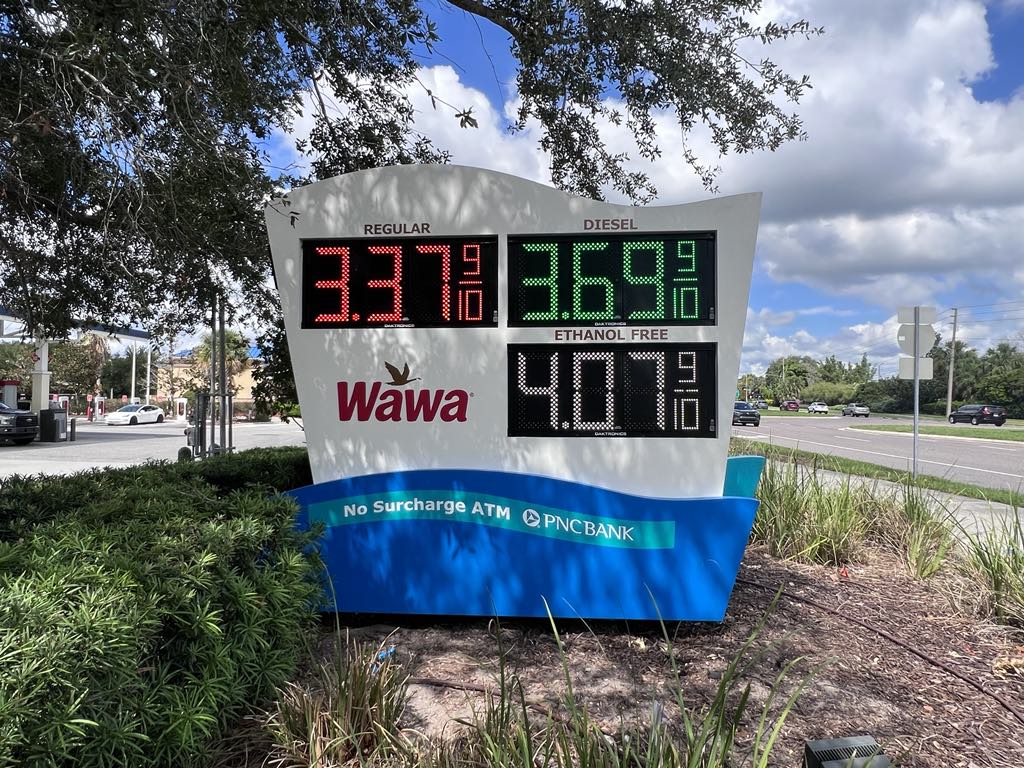
The Most-Changed Sign on Your Lot is Also the One Motorists Read First
Most signs on a fuel site go up once and stay put. The price display is different. It changes as often as your pricing does, sometimes more than once a day, and is the single piece of signage motorists use to decide whether to pull in or drive to the station down the road.
That decision matters more than it might seem. In the NACS Consumer Behavior at the Pump survey, price consistently ranks as the most important factor in where drivers buy gas. The sign showing that number is doing real work every hour you’re open.
Planning a fuel price sign program across your locations? Talk with our team about your sites.
Manual Fuel Price Signs
The traditional option uses changeable numerals, either sliding titles or numbers set on tracks, updated by hand.
The appeal is cost. Manual fuel price signs carry the lowest upfront price and have no electronics to fail. For a low-traffic site that changes prices infrequently, they can be a reasonable fit.
The cost shows up later, in labor and risk. Every price change means someone walking out to the sign, often with a pole, sometimes on a ladder, in whatever weather the day brings. That takes staff away from the store, introduces a lag between your system price and the posted price, and opens the door to transposed numbers that either cost you margin or draw a customer complaint. Across a portfolio, those small frictions multiply quickly.
LED Digital Fuel Price Signs
The electronic option displaces prices on LED digits that update on command, from the counter or from a central office managing many locations at once.
The advantages here are speed and accuracy. A price change happens in seconds, everywhere at once, with no one leaving the building and no transcription error. The digits stay bright and legible at a distance and in low light, which is exactly when a motorist is deciding whether to pull in. For high-traffic sites, frequent price movement, or any operator running many locations, that responsiveness is critical.
The honest tradeoff is the upfront cost. LED price displays carry a higher initial investment than manual numerals, and they are electronic systems that need power, occasional service, and eventual component replacement. For the right site, the labor savings and pricing accuracy earn that back. For a quiet rural station, they may not.
How to Choose Between Them
The decision comes down to a few practical questions rather than a blanket rule.
Traffic volume and price-change frequency matter most. A busy site adjusting prices daily gets far more value from instant updates than a low-volume location that changes prices twice a month. Location count is the next factor, because the labor and consistency benefits of electronic updates compound across a large portfolio. Brand image plays a role too, since a crisp LED display reads as more current than hand-set tiles. And budget sets the frame, including both the upfront number and the labor cost you are already paying to change signs by hand.
There is no single right answer, and many operators run a mix, with LED at their highest-traffic sites and manual fuel price signs where volume doesn’t justify the investment.
What Installation and Maintenance Involves
Whichever format you choose, the sign has to be installed, powered, permitted, and kept running, and that’s rarely as simple as it sounds. Stratus attends to every detail, however.
LED displays need power provisioning and often electrical work to support them. Digital price displays also draw regulatory attention that manual signs avoid, since many jurisdictions limit brightness, placement, and electronic display use. Permitting specialists who know local codes keep those approvals moving rather than stalled. And because a dark or malfunctioning fuel price sign misleads every passing car, uptime matters. A nationwide field partner network backed by on-call service keeps displays accurate across every location without you sourcing a local vendor site by site.
Choose the Right Partner for Your Fuel Price Signs
Stratus has spent decades helping petroleum and c-store brands implement and maintain signage across their footprints, from exterior signage and price displays to permitting, electrical, and ongoing service, all through one program.
Ready to choose and roll out the right fuel price signs? Start the conversation with our team.