
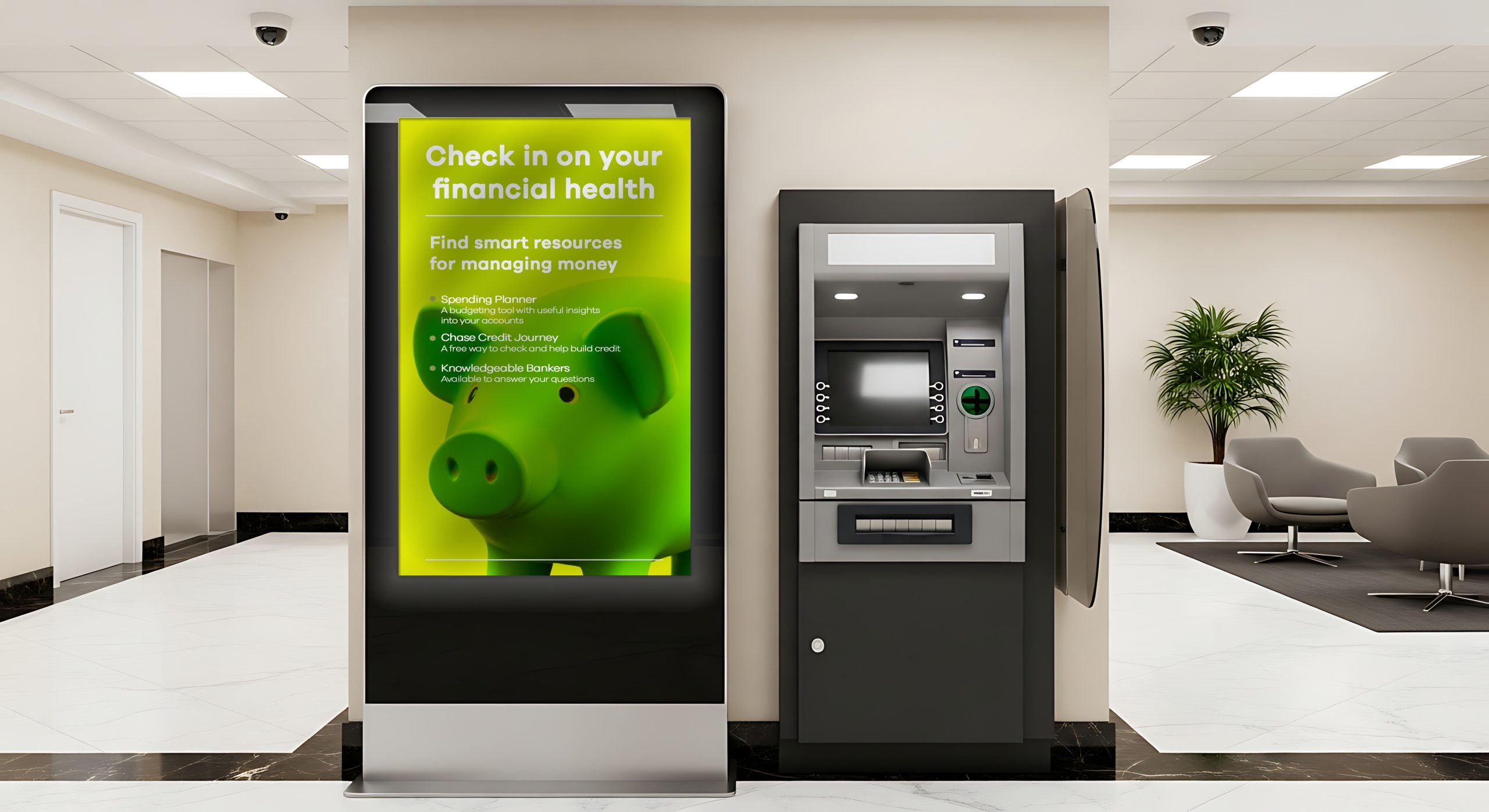
The Hardware Was the Easy Part
Walk through a set of bank branches that installed digital displays in the last few years and the same pattern shows up. A few screens are doing real work. More often, a brand video loops silently above a waiting area where nobody looks up, or the content has not changed since installation day, or the display is showing an operating system error and has been for weeks.
The hardware decision was the easy part, and most institutions have already made it. What separates displays that earn their cost from displays that become furniture is a set of choices made after the purchase order.
Want a straight assessment of what your branch displays are actually doing? Connect with our team.
What Works
Screens positioned where people are already standing still. Dwell time is the entire currency. Teller queues, ITM waiting areas, drive-thru lanes, and the seating outside a banker’s office give a customer several minutes and nothing to do. A display in a lobby people walk straight through is decoration.
Content tied to something that actually changes. Current deposit and lending rates, local branch hours, appointment availability, and service updates give a customer a reason to read the screen a second time. This is the single strongest use case in banking, because the underlying information is genuinely dynamic and genuinely useful.
Wayfinding in larger branches and financial centers. Directing people to the right service area reduces friction at the door and lowers the number of interruptions that your staff field. It is unglamorous, but it works.
Community and local content. A screen showing a local sponsorship, the branch team, or a neighborhood event does something a mobile app cannot. It makes the location feel like it belongs to that market.
What Doesn’t
Repurposed marketing video. A 30-second spot built for broadcast is engineered to interrupt. A branch screen has the opposite job: it is read by someone with time to spare who came in looking for information. Running the ad reel makes the screens feel like advertising in a place customers came to for service.
Consumer displays in commercial duty cycles. A television built for a few hours of household use per day will fail early when run for 12 hours a day, every day, often in direct window light. The replacement cost and the service calls erase whatever was saved at purchase.
Screens without a named content owner. This is the failure mode behind almost every stale display. When updating content is nobody’s specific job, it becomes nobody’s job. The screen freezes at whatever was loaded on install day and slowly becomes evidence that the branch is not paying attention.
Displays placed for the installer’s convenience. Placement driven by the nearest data drop rather than by where customers stand is a decision made for someone else’s schedule.
The Compliance Layer That Catches Institutions Off Guard
Financial institutions have a signage obligation that retailers do not, and the rules governing it have been in motion for three years.
The FDIC issued a final rule in January 2026 amending Part 328 signage requirements for institution websites, mobile applications, and automated teller machines and devices. It took effect March 2, 2026, with a compliance date of April 1, 2027.
Scope is where branch teams get tripped up. Those provisions govern digital deposit-taking channels and ATMs and similar devices. A promotional display in a lobby is generally a different object than an ITM screen where a customer completes a transaction, and the physical official sign requirement inside the branch is separate again. Treating every screen in the building as one regulatory category, in either direction, is how institutions end up either over-engineering a lobby display or missing a requirement on a device that does fall in scope.
This is a question for your compliance team and counsel, not your signage vendor. What a signage partner owes you is knowing which of your displays are which, and being able to update the ones in scope across every location on a deadline. Stratus supports ATM and ITM signage alongside branch interior branding, so those assets sit in one record rather than two vendor systems.
The Part Nobody Budgets For
Digital displays are the only signage asset in a branch that can fail silently. An unlit channel letter is obvious from the parking lot. A screen showing the wrong rate, or nothing at all, looks fine from a distance and can stay broken for a month.
That is a maintenance problem, solved the way the rest of the branch estate is: scheduled checks, field techs who can report and resolve during a visit, and program management technology that makes a dark screen visible at the corporate level. A brand maintenance program already covering lighting and exterior signage can cover displays on the same trip.
Getting the Second Decision Right
Banking digital signage solutions rarely fail on the hardware. They fail on placement, on content ownership, on the assumption that a screen installed is a screen working, and on unclear thinking about which displays carry regulatory weight. Institutions that get those four things right end up with screens customers actually use.
Stratus works with financial institutions nationwide, supporting branch signage, ATM and ITM programs, interior environments, and ongoing maintenance through 4,000+ field partners across 50 states and 24 countries.
Ready to make your branch displays do something? Contact our team today.